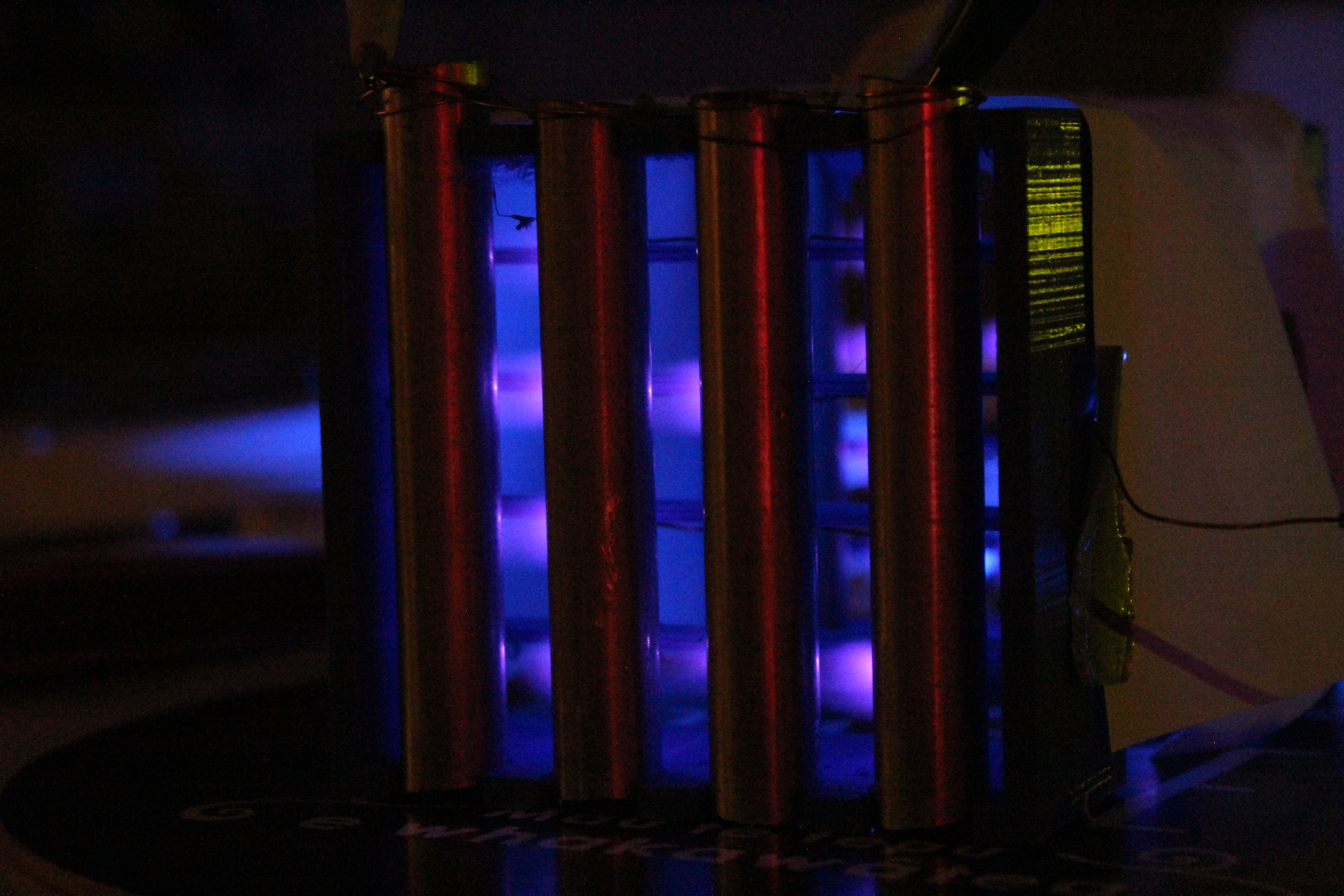
Electrohydrodynamic (EHD) thrusters often referred to as Ionic thrusters are commonly found within space flight in a vacuum with notable engines like NASAs AEPS - HERMeS thruster which uses the most common type of electrode arrangement which is a positive electrode which strips electrons from air particles causing them to become positive ions which are attracted to the negative plate which then gives a net momentum gain. However, for this investigation a different type of EHD thruster was used this uses a negative cathode and electrons which are in an even corona discharge to be formed in the direction from the negative electrode to the positive electrode. The corona discharge causes collisions between charged and neutral particles which results in a net directional momentum transfer creating the effect of “Ion wind”. The thrust produced by this corona discharge is called Electrohydrodynamic (EHD) thrust. Both of these methods are classified as ionic thrusters. Currently, there is a developing area of research into atmospheric ion propulsion. This is the type of propulsion that is being investigated within this science fair investigation. To the right is a figure of the type of thruster where electrons travelling from the negative collide causing a net momentum gain for the air particles.
The Modular Atmospheric Ion Thruster (MAIE) was a development project conducted by Benjamin Jordan into Electrohydrodynamic thrusters. Within MAIE a round pipe was chosen for the positive electrode because a round positive electrode will minimize any direct paths to be formed. This allows for an even corona discharge to be formed in the direction from the negative electrode to the positive electrode. MAIE was designed with rapid prototyping and qualitative evidence. This could have been improved with the use of quantitative evidence to improve efficiency. The MAIE consists of 3 removable modules. During development, it was evident in the theoretical equations and observed results that a circuit of high power was required for measurable force for flight and testing. This meant that research into high-power and voltage circuits was required. This lasted from August 2023 to June 2024. It was originally envisioned that a ZVS circuit was going to be used, however, it was decided to use a simple inverter, transformer, and rectifier circuit allowing for higher power operations. During testing acquiring data was difficult due to the lack of specialist equipment. Safety concerns were also present, thus giving limited data with large errors. What has been achieved during this investigation is a modular atmospheric EHD thruster generating thrust with point electrodes and being able to gain a deeper understanding of advanced methods of propulsion. The results from this investigation were inconclusive due to a significant range of errors in the measured data and safety concerns. The MAIE project ended and P.H.A.N.T.O.M has taken its place as Benjamins research into advance propulsion systems.